OpenDataDSL
Proof of Concept
A FREE Proof of Concept (PoC) offers several compelling benefits, especially if you are migrating from a legacy platform.
FREE Proof of Concept
What is included?
- Full access to the entire platform for up to 10 users
- Full access to Fusion AI
- Up to 3 end-to-end use cases which we will either implement or help you implement
- A dedicated customer support representative who will work with you at all times
- A shared PoC project in our built-in project management extension, where every success criterion is proved with evidence and signed off by your team
- If you require specific licensable data loading, you must have the required license or arrange a trial access
When It's Especially Valuable
- You're comparing multiple vendors or solutions.
- You're introducing unfamiliar or complex technology.
- Budget or stakeholder approval hinges on demonstrated success.
Evidence-based proof, signed off in the platform
A proof of concept is only as good as its proof. We run every PoC as a project in Projects, the project management extension built into OpenDataDSL, shared between your team, ours and any implementation partner. Each success criterion you set becomes a task that needs evidence and a formal sign-off by a person you name. The evidence is the platform itself, live: not slides, not spreadsheets.
1. Agree the success criteria
For each use case we agree what success looks like and who on your side signs it off. The evidence needed is prepared on the task from day one, so everyone can see what is still to prove.
2. Build it on the platform
We load your data, build your curves and connect your systems, working with you in the shared project. Every email, call, meeting and decision is kept on the task it is about.
3. Attach the evidence
Each task links to the real thing in the platform, read live whenever anyone opens it, so the proof is always current.
4. You sign it off
The person you named reviews the evidence and signs it off, or rejects it with a comment. Their name, the time and the comment are recorded; if the evidence changes later, the sign-off is withdrawn.
5. Report to your stakeholders
The Project Status report shows every success criterion, its evidence and who signed it off: ready for the steering committee, the business case or the procurement file.
6. Carry straight on
The signed-off evidence stays in your tenant. A successful PoC moves into implementation with the same plan, people and history.
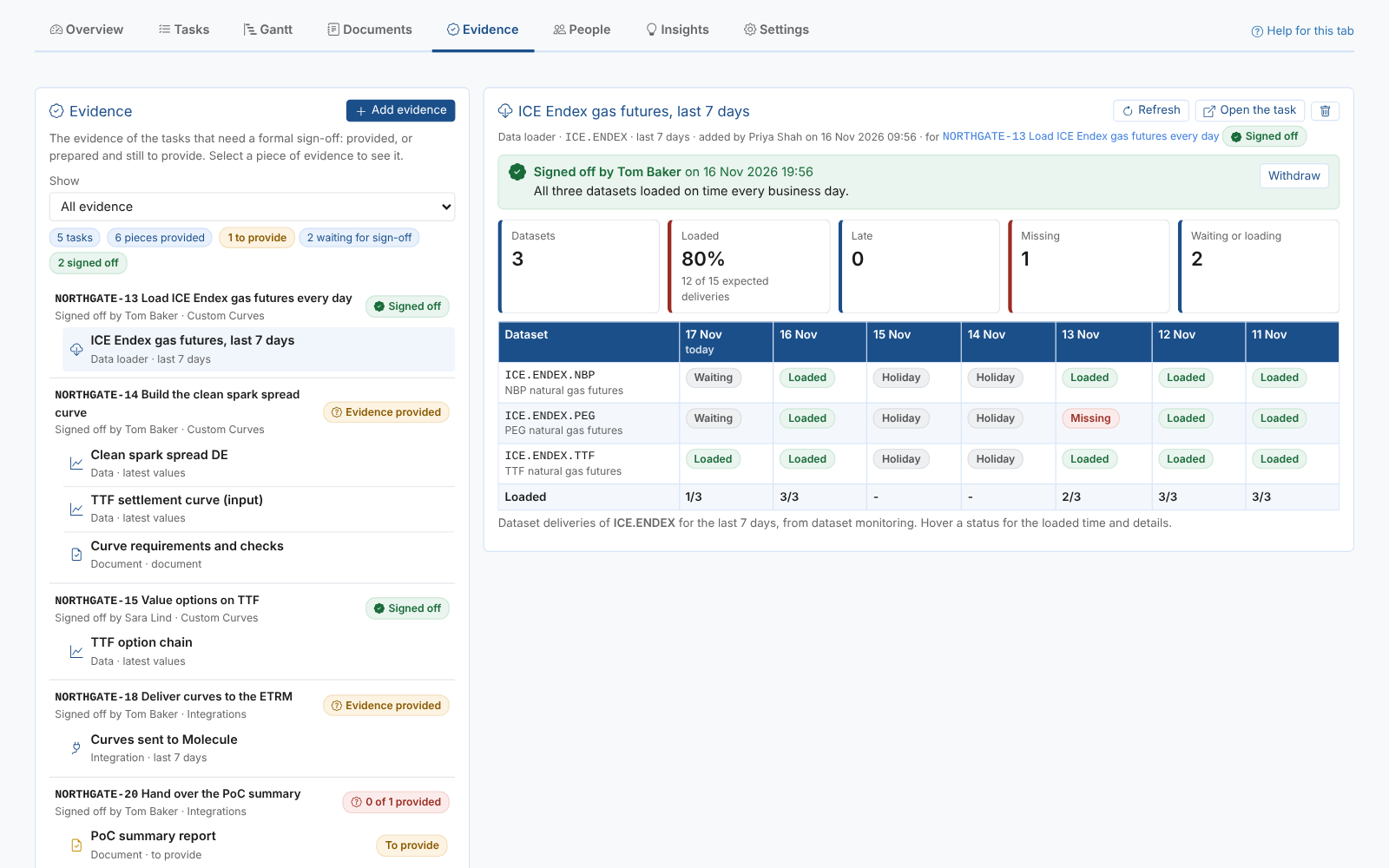
The Evidence tab: every success criterion with its evidence and status. Here, a week of ICE Endex gas futures loads, signed off by the prospect.
What counts as evidence
Evidence is taken from the platform as it runs, so nothing can be dressed up for the demo.
Data loading
A data feed and every dataset in it, with its loading status for each day: loaded, late, missing or a holiday. Proof that your data arrives, on time, day after day.
Curves, timeseries and options
The data itself, charted: the latest values of a timeseries, or a forward curve or option chain for any date you choose, so you can check it against your own numbers.
Integration deliveries
What was sent to your ETRM or downstream system each day: items sent, failed or held back, and why.
Documentation
The logic behind a curve, its data sources, script and design choices, written next to the curve itself; and evidence documents for anything else, from a standard template.
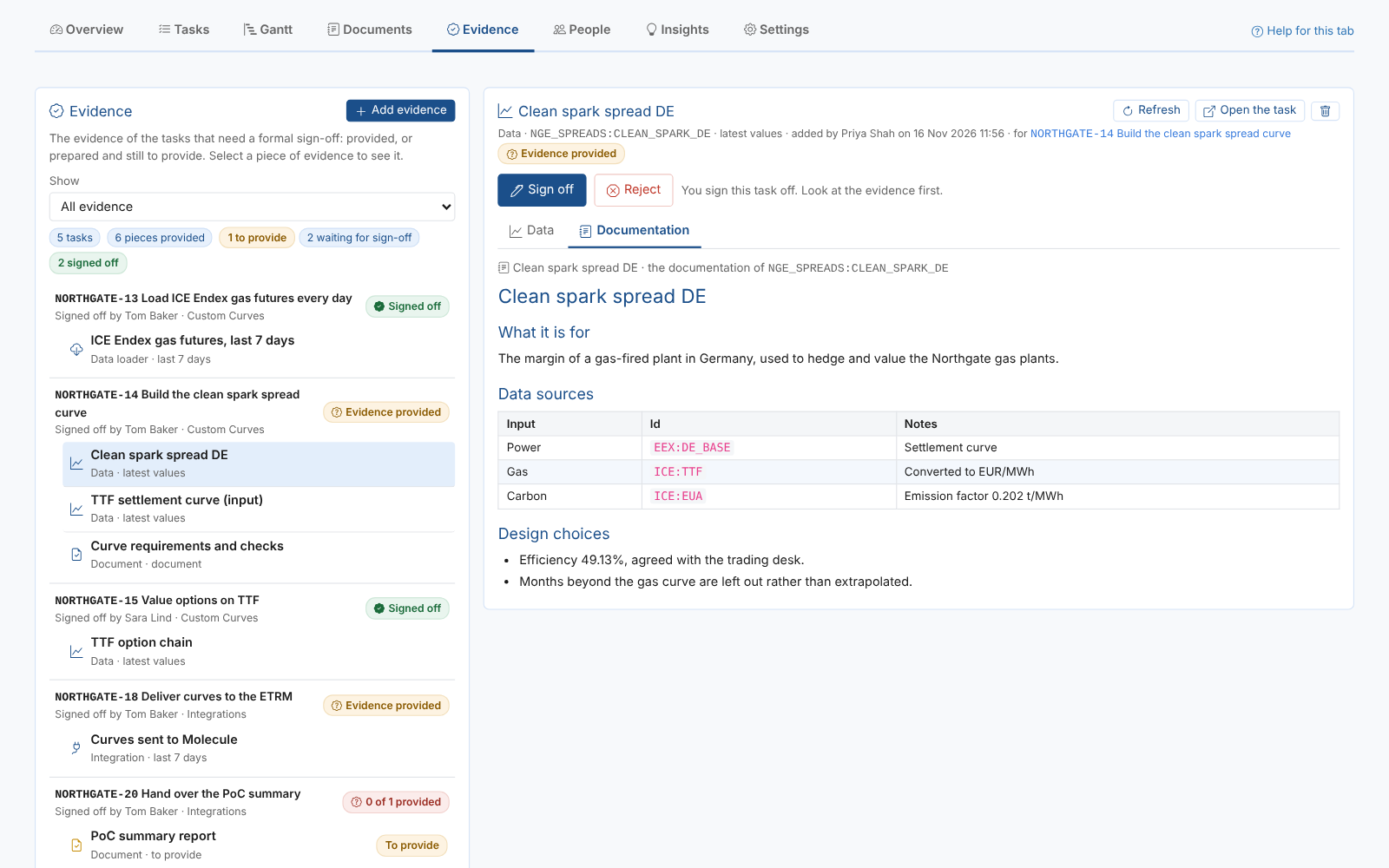
A smart curve as evidence, with its documentation: the reviewer sees the logic as well as the numbers.
Signed off by you, recorded for everyone
A formal sign-off
Only the person you name for a criterion can sign it off. They see exactly which evidence they are signing for, can add a comment, and can mark the task done in the same step. A rejection says what is wrong or missing, so our team knows what to do next.
A report your stakeholders can trust
The Evidence and sign-off view of the Project Status report lists every criterion, the evidence behind it, who signs it off and when they did. Download it as CSV for your evaluation file.
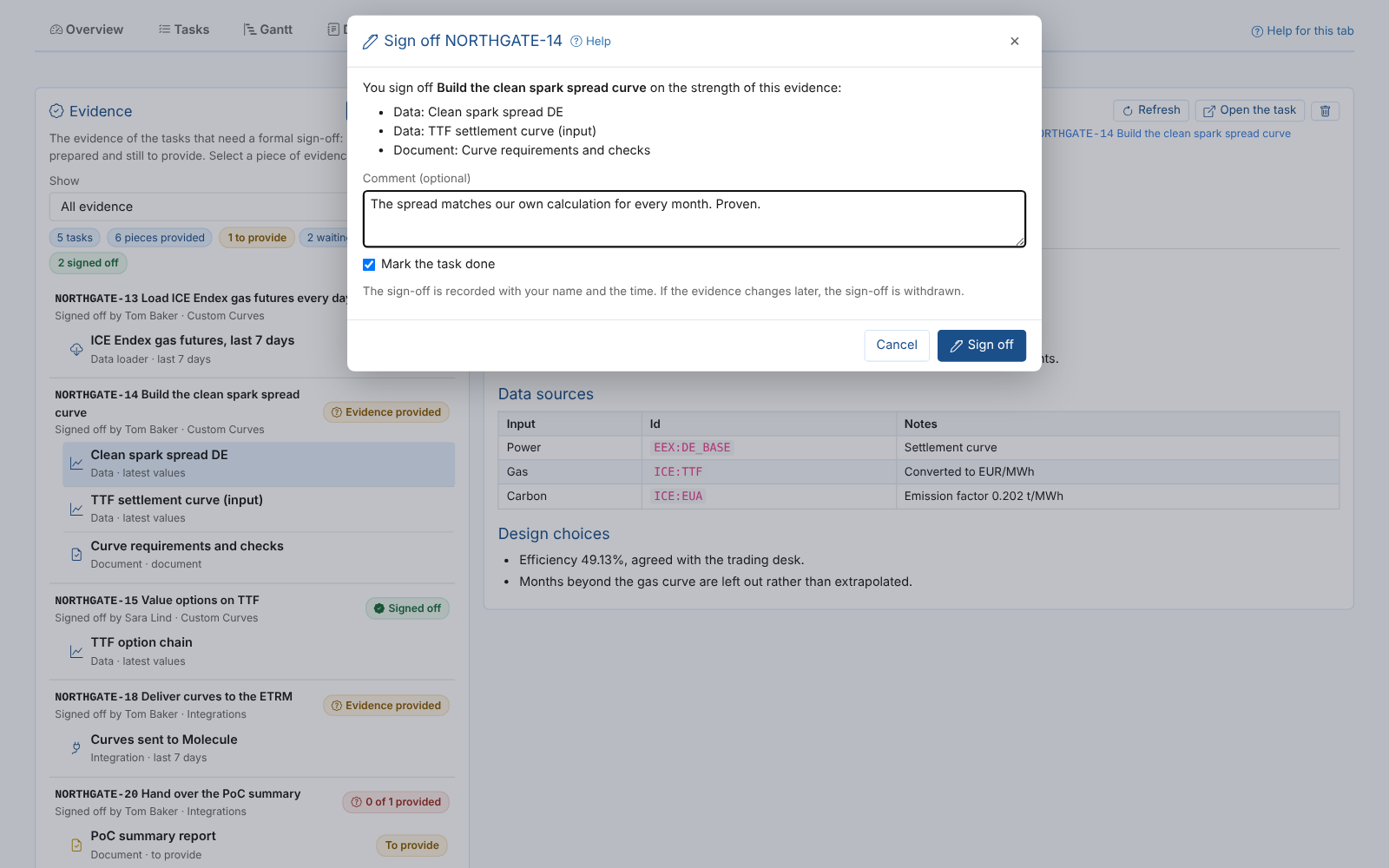
Signing off: the prospect signs on the strength of the evidence listed, with their own comment.
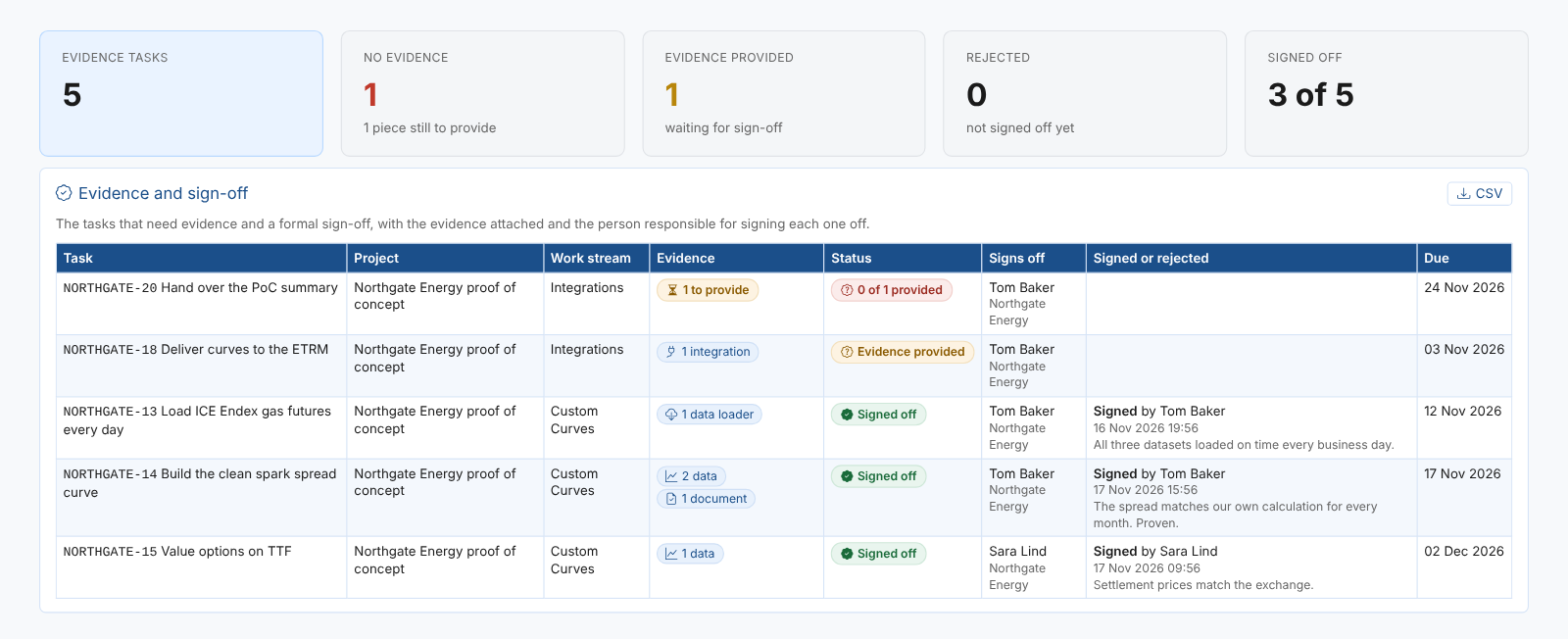
The Project Status report: where every success criterion stands, and who signed it off.
Advantages
Here's a breakdown of the advantages:
Risk-Free Evaluation
Low commitment: You can assess the value and effectiveness of a solution without financial investment.
Test compatibility: Ensure the proposed solution integrates well with your current systems and workflows.
Informed Decision-Making
Real-world results: A PoC gives you tangible data and outcomes rather than relying solely on vendor claims or theoretical benefits.
Stakeholder buy-in: Demonstrating a working model can help convince internal stakeholders and decision-makers.
Faster Time-to-Value
Quick setup: Most PoCs are designed to deliver results within a short timeframe, helping you identify benefits early.
Accelerates deployment: If successful, a PoC ideally leads directly into implementation, reducing delays.
Customized Insights
Tailored scenarios: The PoC is typically aligned with your specific use case, offering a clearer picture of how the solution addresses your needs.
Hands-on feedback: Your team can interact with the solution and provide input, shaping the final implementation.
Vendor Accountability
Performance proof: We can demonstrate that our platform performs as promised.
Service quality check: Evaluate our responsiveness, expertise, and support during the PoC.
Cost Savings
Avoid sunk costs: If the solution doesn’t meet your needs, you haven’t spent money unnecessarily.
Better ROI: Choosing the right solution the first time leads to a more efficient and cost-effective long-term investment.
Ready to get started?
Fill out your details below and somebody will be in contact with you very shortly.