OpenDataDSL
Alerts
Every problem with your data, in one place until it is solved
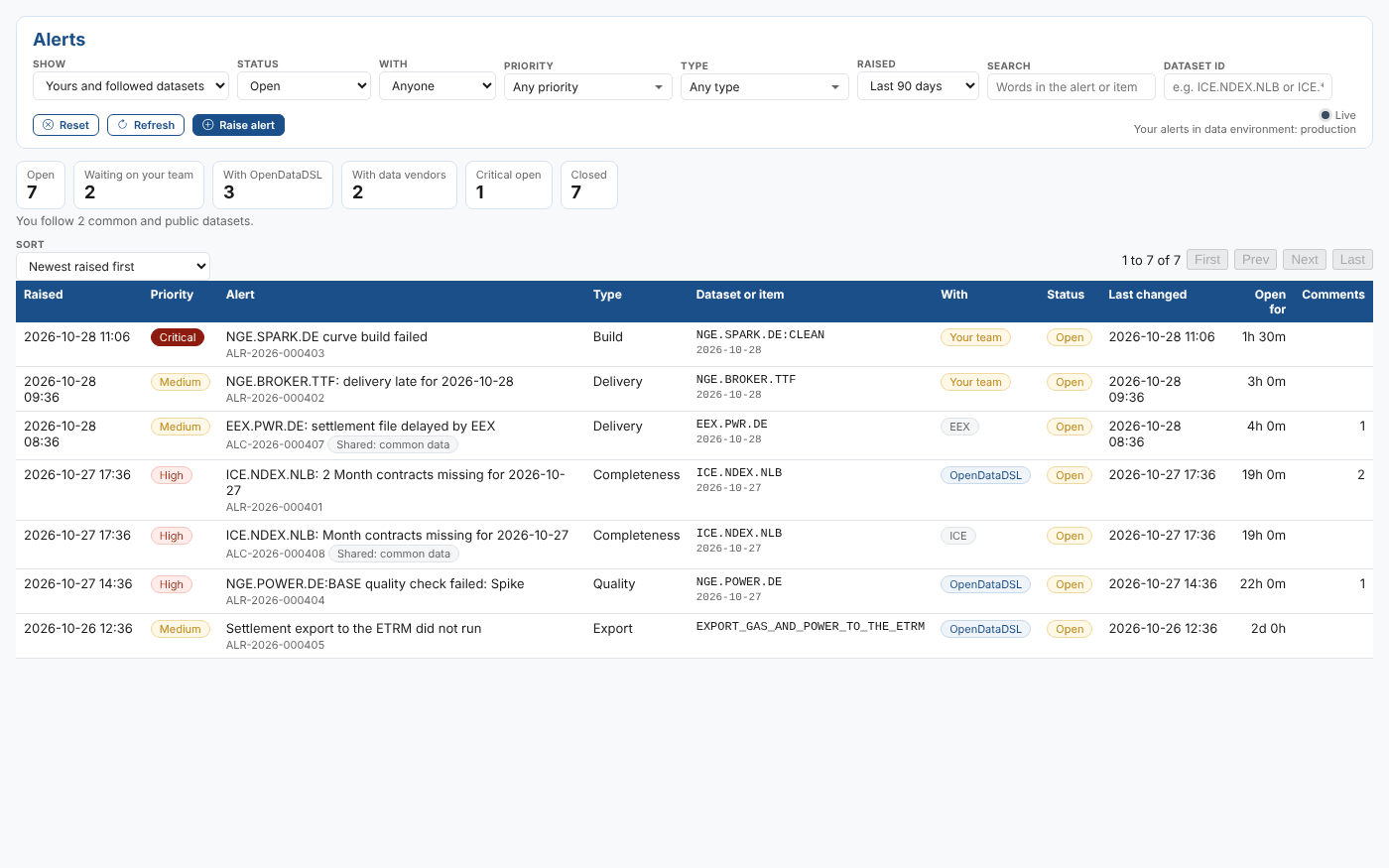
When a delivery is late, a check fails or a curve does not build, an alert is raised and tracked like a support ticket: who has it, what was done, and how long it took.
The Data Operations Challenge
The Challenge
Every morning someone has to find out what went wrong with the data overnight:
- A vendor delivery that arrived late or incomplete
- A quality check that failed
- A curve that did not build
- An export to the ETRM that did not run
The answers are spread across emails, logs and chat messages. One failed load causes a dozen separate warnings, and nobody is sure whether the problem is with your team, with OpenDataDSL or with the data vendor.
When the problem is solved, there is no record of what happened, how long it took, or what was done about it.
Our Solution
The platform raises an alert when something goes wrong with your data, and your team can raise alerts too, to ask OpenDataDSL for help or to keep track of a problem yourselves.
An alert works like a small support ticket. It stays open until the problem is solved, it is always with someone, and everything that happens to it is kept on its timeline.
The Alerts screen puts them in one place, with the dataset delivery behind each one, and updates as things happen.
Alerts: Know What Is Wrong, Who Has It, and When It Was Fixed
Key Benefits
Replace scattered warnings and email threads with one shared view of every problem with your data.
Raised for You
Deliveries, quality, builds and exports.
The platform raises alerts when a dataset delivery is late or incomplete, a quality check fails, a curve does not build or an export does not run, each with a priority and a type.
Always With Someone
Your team, OpenDataDSL or the vendor.
Every alert says who has to act next, and hand-overs are recorded. The time an alert spends with each party is measured, so you can see where problems wait.
One Alert per Problem
Root causes.
When a data load fails, the late datasets, failed curves and failed exports it explains are recorded on its alert instead of raising alerts of their own, and recover by themselves when the data arrives.
Shared Alerts for Common Data
One problem, everyone informed.
Alerts about common and public data are raised and managed by OpenDataDSL for everyone who uses it. Read them, and add comments only your team and OpenDataDSL see.
Told Wherever You Are
Email and Microsoft Teams.
Automations send an email or a Teams message when an alert is raised, closed, handed over, changes priority or gets a comment, for every alert or only the data you care about.
A Record of Every Problem
Timelines and insight reports.
Every comment, hand-over, priority change and resolution is kept. Insight reports show who did what and when, the whole history of any alert, and response times.
How Alerts Work
In the Portal
Open Operations, Alerts to see your alerts and the shared alerts about the datasets you follow.
Find: filter by status, who has it, priority, type and dataset, or search the text.
Open: an alert's details, its timeline, and the dataset delivery behind it: what arrived, what is missing, and what the quality checks said.
Work on it: comment, hand it over, change the priority, close it with a resolution, or reopen it within 7 days.
From Your Code and Systems
Alerts work everywhere you do:
ODSL and Python: find, read, raise, comment on and close alerts from your scripts and notebooks.
REST API: the same from any language or system.
No duplicates: raising an alert with the key of an open alert counts another occurrence instead of creating a second one.
Traced: every piece of work a process run starts carries its trace id, so a failed build an hour later is matched to the load that caused it.
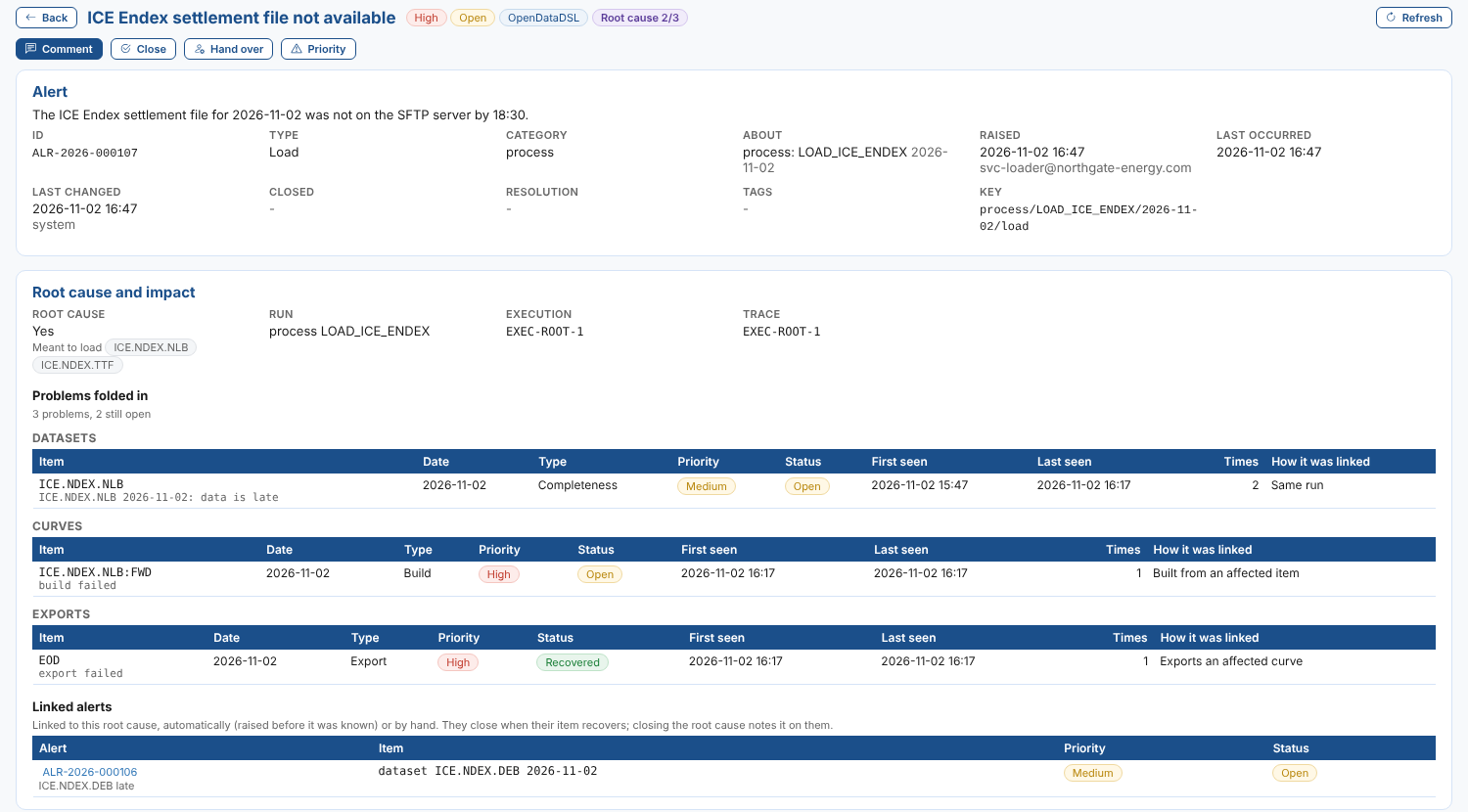
One root cause alert for a missing settlement file, with the datasets, curves and exports it affected.
Real-World Applications
How energy and commodity teams use Alerts every day.
An Incomplete Vendor Delivery
Last night's ICE Endex delivery was missing contracts. The alert shows what arrived and what is missing, and that it is with OpenDataDSL, who are chasing the vendor.
A Failed Load and Its Consequences
The evening settlement file did not arrive. One alert holds the incomplete dataset, the curve that did not build and the export that did not run, and each recovers when the file arrives.
A Morning Check for the Team
The figures at the top of the screen show what is open, what is waiting on your team, and what is critical, so the day starts with the problems that matter.
Asking for Help
Raise an alert for OpenDataDSL when something looks wrong. The conversation, the hand-overs and the resolution are kept on the alert for anyone who needs them later.
Integration with Platform Capabilities
Alerts collect the problems the rest of the platform finds
From Scattered Warnings to One Shared View
Alerts give your operations team one place to see what is wrong with the data, who is working on it and what has been done, instead of piecing it together from emails and logs.
Problems are solved faster because everyone knows who has them, and every resolution is recorded, so the next time the same problem comes up the answer is already there.
See Your Data Problems in One Place
Book a demo and we will show how alerts on your datasets, curves and exports are raised, worked on and resolved.
Get Started TodayExtensions
How about a demo?
Our team is here to find the right solution for you, contact us to see this in action.
Fill out your details below and somebody will be in contact with you very shortly.